Sunday, 18 September 2011

ஐ-ஃபை(Eye-Fi)....

ருக்கு கிளம்பும் முன் அவசர அவசரமாக இந்த பதிவு.Eye-Fi-பற்றியது.இந்த மாதிரியான அற்புத தொழில் நுட்பங்களை பற்றி கேள்விப்படும் போது உடனே எழுதிவிட வேண்டும். நம்மில் அநேகருக்கு இது ஏற்கனவே தெரிந்த விசயம் தான். தெரியாதவர்களுக்கு மட்டும் இந்த அறிமுகம். சாதாரண மெமரி கார்டுக்கு உயிர்கொடுக்கும் தொழில் நுட்பம் இது. memory card + Wi-Fi = Eye-Fi எனும் சமன்பாட்டை பயன்படுத்தியிருக்கிறார்கள். அதாவது உங்கள் SDHC மெமரிகார்டால் Wi-Fi எனப்படும் வயர்லஸ் நெட்வொர்க்கோடு இணைய முடியும். அவ்ளோதான். இதனால் என்ன பயன்? உங்கள் சாதாரண டிஜிட்டல் கேமராவில் இந்த Eye-Fi மெமரிகார்டை பயன்படுத்தினால் உங்கள் கேமரா உங்கள் வீட்டு வயர்லஸ் நெட்வொர்க்கோடு இணைக்கப்பட்டு விடும்.விளைவு போட்டோ எடுக்க எடுக்க அப்படியே வை-பை வழி உங்கள் கணிணிக்கோ அல்லது ஐபோன்/ஐபேடு/ஆண்ட்ராய்டுக்கோ போட்டோக்களை எளிதாக கடத்திவிடலாம். உங்கள் மெமரி கார்டு எப்போதுமே போட்டோக்களால் நிரம்பிவழியாது.never run out of space again, எப்படி கான்செப்ட்? எப்படியெல்லாம் யோசிக்கிறார்கள் பாருங்கள்? இங்கு ஆப்டிமம் மற்றும் AT&T வைபைகள் ஊரெங்கும் உள்ளன. எனவே எங்கிருந்து வேண்டுமானாலும் போட்டோக்களை சாதாரண டிஜிட்டல் கேமராவிலிருந்து அப்லோடு செய்துவிடலாம். இன்னும் அநேக நம்ம வீட்டு சாதனங்கள் சீக்கிரத்தில் உயிர்பெற்று வீட்டு வயர்லெஸ் நெட்வொர்க்கோடு இணைக்கப்படும். அந்த வழியில் டம்ப் பொருட்களைக்கூட நெட்வொக்கில் இணைக்க நாம் ரொம்ப கஷ்டப்படவேண்டியதில்லை என்பதை இந்த ஐ-பை நிரூபிப்பதாய் உள்ளது.

மீண்டும் cleartrip.com இந்திய ரெயில்வே ரெசர்வேசன்களுக்கு உதவியது.www. irctc.co.in -னோwww. makemytrip.com -மோ அல்லது yatra.com-மோ சர்வதேச அல்லது குறைந்த பட்சம் அமெரிக்க கிரெடிட்/டெபிட் கார்டுகளை ஏற்றுக் கொள்ளவில்லை. flykingfisher.com-ல் கூட முன் பதிவு செய்ய cleartrip.com - தான் உதவியது.Long live cleartrip.com. ஆன்லைன் coupon code-களையும் கவுரவிக்கிறார்கள். பல சென்னை ஹோட்டல் ஆன்லைன் ரெசர்வேசன் தளங்கள் அநியாயத்துக்கும் இருக்கின்றன. பக்காவாக வெளிநாட்டு ஓட்டல்களுக்கு வெப் பக்கங்களை வடிவமைக்கும் நாம், நம்ம ஊர் ஸ்டார் ஹோட்டல் ஆன்லைன் ரெசர்வேசன் தளங்களை பார்க்கவேண்டுமே, பாழடைந்த மண்டபத்தினுள் நுழைவது போல் இருக்கின்றது. வியாபார விரிவாக்கத்தில் கவனம் செலுத்தும் நம்மவர்கள் ஆன்லைன் அப்பியரன்ஸ்சிலும் கவனம் செலுத்தினால் நன்னாய் இருக்கும்.தூரத்து வாடிக்கையாளார்களுக்கு அந்தந்த இணைய தளங்களே அந்த வியாபாரம் பற்றிய மறைமுக நல்லெண்ணத்தையும் நம்பிக்கையின்மையினையும் கொடுக்கும் என்பதை அறியவேண்டும்.

Friday, 16 September 2011

The world’s tallest hotel with world’s largest clock Built in Holy Mecca..


THE ABRAJ AL BAIT COMPLEX IN SAUDI ARABIA, WITH IT'S ICONIC GIANT CLOCK, HAS EXPLODED ONTO THE WORLD'S ARCHITECTURAL LANDSCAPE, BLOWING A NUMBER OF RECORDS SKY HIGH.
Dubai’s Burj Khalifa might be the world’s tallest building, but the new, multi-billion-dollar, sky’s-the-limit Abraj Al Bait complex in Mecca, Saudi Arabia has a number of extreme world records of its own.
Try some of these for size: it boasts the world’s tallest hotel, on top of which is the world’s tallest four-sided clock tower and the world’s largest clock. When combined with the six other towers in the complex, it has the largest floor area of any building in the world at 1.5m m2, and can accommodate 65,000 people at any one time. It is building of Brobdingnagian proportions.
The centre piece of the complex is the world’s second tallest building, the 601-metre (1,972 feet) high Mecca Royal Clock Tower that looms over the Masjid al-Haram mosque and the Kaaba – the cuboid-shaped building that is the most sacred site in Islam.
It may not be to everyone’s taste, but there’s no doubting the clock tower makes an impression
The Mecca Royal Clock is four-sided, and each dial measures a staggering 43 metres across. To put that into perspective, London’s Big Ben (or St Stephen’s Tower, if we’re being pedantic) has dials of just seven metres in diameter.
Sticking with the same comparison, Big Ben makes do with 28 light bulbs per dial, while the Royal Mecca Clock’s dials are each packed with over two million LEDs. Added to that, it has a further 21,000 lamps that beam white and green lights to a distance of 30km, five times a day, calling people to prayer.
Each clock face is 43 metres in diameter and is illuminated by two million LED lights
The clock ticked its first tock in August last year, in time for Ramadan. The clockwork itself was engineered by Swiss firm Straintec, weighs 21 tonnes and runs on Arabia Standard time, three hours ahead of GMT.
Built by the Saudi Binladin Group, the complex cost an estimated $15 billion (roughly the same cost as hosting the London Olympics) and is part of a plan to triple the number of pilgrims that Mecca can handle during the annual Hajj pilgrimage to 35 million .

Collection by: M.Ajmal Khan.

Thursday, 15 September 2011

Scaffolding and its uses...

Scaffolding is widely used on construction project. The quality and durability are the main essential parts of it because it supports the workers.Scaffolding platforms help all kinds of workers reach places difficult to reach even on ladders. Carpenters and construction workers, painters, maintenance workers and electricians all use scaffolding. There are many different types of scaffold platforms with different support systems to accommodate the various job requirements. Now, if we take closer look, we will find that there are three different types of scaffolding. Each type serves for different function as well. Let’s take a look.

What Are the Different Types of Scaffolding?

Access Scaffolding, Aluminium Scaffolding, Chimney Scaffolding, Commercial Scaffolding, Domestic Scaffolding, Exterior Scaffolding, Facade Access, Facade Scaffolding, Guttering Scaffolds, Independent Scaffolding, Industrial Scaffolding, Inside Scaffolding, Putlog Scaffolding, Roofing Scaffolds, Scaffolding, Span Deck, Stage Scaffolding, Support Scaffolding, System Scaffolding, new builds, Roofs, Call outs, Home owners.

Types Of Scaffolding And its Uses..

There is a surprising range of scaffolding types that can be used in construction and for other purposes. The general principle of a scaffolding construction, whether it is a static, rolling, or any other type of construction, remains the same – to provide a platform for workers and materials while work takes place.
Most often seen in construction projects, scaffolding structures and other constructs can be used for a variety of purposes. It is common to see scaffolding being used for repair work, to access high objects, for window cleaning tall buildings, and more. Choosing the most appropriate form of scaffold structure is an important stage in the project that you are undertaking.

1,Supported Scaffolding

This is the most commonly used form of scaffolding and is the type that you will see being used in construction work and on most other forms of work where elevation is required. Extra support may be required if the scaffolding will be long or required to take a lot of weight.

Supported scaffolding is built from the base upwards, and will normally be used wherever possible. It is considered the easiest, most convenient, safest, and most cost effective form of scaffolding construct. Different forms of supported scaffolding are available, and each will serve a very specific purpose and used in specific circumstances.

2,Suspended Scaffolding

Suspended scaffolding is typically suspended from a roof or other tall construct. It is most commonly used when it is not possible to construct a base, or where access to upper levels may be required, and the building of scaffolding from floor to the required level would be impractical.
This type of scaffolding is commonly used by window cleaners on tall buildings, but may also be seen where repairs are needed to the exterior of upper levels of similarly tall buildings. Supported scaffolding is usually preferred where possible.

3,Rolling Scaffolding

Rolling scaffolding is a similar type of construct to supported scaffolding, but rather than offering a stable base, it uses castor style wheels that enable the base to be moved. This is a useful form of scaffolding when you need to complete work over a longer distance than a single scaffolding construction would permit.
The wheels should be locked when workers or materials are on the scaffolding, in order to ensure the safety of those using it, and those around it.

4,Mobile Scaffolding

There are a number of factors to consider when deciding whether to use static or mobile scaffolding. Ease of access is one such consideration, along with the amount of movement on the scaffolding itself. Where possible, you should rely on the use of a single scaffolding structure, or a number of structures, because mobile units, while perfectly safe when well-constructed and used properly, do pose more of a hazard than mobile constructs.
Most scaffolding is considered semi-permanent. Once used, it can be taken apart and moved to another location before it is constructed again. Fixed scaffolding can be left in position for longer periods of time, making it especially useful in those situations where permanent access may be needed to elevated positions.

5,Aerial Lifts

Aerial lifts should be used where workers need to be able to access a number of levels in order to be able to complete a construction. For example, if building work is being completed on the outside of a multi-storey property and both workers and materials will be needed to work outside two or more floors, at different times, then an aerial lift will make it easier and safer to lift even large amounts of material, and multiple workers to the levels required.

Erection Precaution..

Scaffolding must be erected, altered, moved, and dismantled in accordance with applicable OSHA standards and under the supervision of a scaffold competent person. Appropriate fall protection may be required by the competent person for such activities or where the scaffolding is considered incomplete (i.e. missing parts due to area obstructions). 

Scaffold components cannot be mixed if they are from different manufacturers unless they fit together without force. Scaffold components of dissimilar metals should not be used together, unless the competent person has determined that galvanic action will not reduce the strength of any component. 

Base /Footing

base plate

assembly

Supported scaffold poles, legs, posts, frames, and uprights shall bear on base plates and mud sills (or other adequate firm foundation). The size of the mud sill shall be based on the type of soil the scaffold will be erected upon.

Minimum Mud Sill Size
Scaffolds 4 levels or less in height
2" x 10" pad, 12" - 18" long
Scaffolds > 4 levels on Type A Soil
2" x 10" pad, 18" long
Scaffolds > 4 levels on Type B Soil
2" x 18" x 18" pad
Scaffolds > 4 levels on Type C Soil

2" x 36" x 36" pad
mud sillThe base and mud sill must provide a solid surface for the feet to sit upon so that the scaffold doesn't sink, move, settle, or shift. Unstable objects, such as bricks, cinder blocks, buckets, scrap lumber, etc., shall not be used to support or level scaffolds. Screw jacks must be used to level scaffolding on uneven surfaces. The maximum extension for a screw jack is 18 inches high. Most screw jacks will have a built-in stop so that the maximum height cannot be exceeded. (For mobile scaffolds, the maximum height of the screw jack is 12 inches.)

Plumb/Level/Square..

Supported scaffold poles, legs, posts, frames, and uprights shall be plumb (i.e. scaffoldperfectly vertical) and braced to prevent swaying and displacement. Cross bracing is required on both front and back sides of each scaffold buck or frame.
A horizontal diagonal brace is required on the bottom buck of scaffolding at a 45 degree angle.
To check a scaffold for being plumb, use a level on two opposite uprights. To make sure the scaffold is level, use a level on a horizontal support or bearer. To ensure the scaffold is "square", use a tape measure and measure the distance between opposite corners. The two measurements should be equal.

Securing..

Scaffold frames (i.e. bucks) must be joined together vertically by coupling or stacking pins (or equivalent means).
brace and tieScaffolds with a height-to-base width ratio of more than four to one shall be restrained from tipping over by guying, tying, bracing, or equivalent means. Guys, ties and braces shall be installed where horizontal members support both inner and outer legs. Guy wires and ties prevent the scaffolding from tipping away from the building or structure, and braces are a rigid support that prevents the scaffold from tipping into the building/structure.

Vertical Securing

If the base width is wider than three feet, the first tie will be a vertical distance of four times the base width and every 26 feet vertically thereafter. For example, if the base width is 5 feet, the first vertical tie will be (5 feet x 4) 20 feet from the ground.
large scaffoldIf the base width is three feet or less, the first tie will be a vertical distance of four times the base width and every 20 feet vertical thereafter. For example, if the base width is three feet, the first vertical tie will be (3 feet x 4) 12 feet from the ground.

Horizontal Securing

For long (running) scaffolds, guys, ties, and braces shall be installed at each end of the scaffold and at horizontal intervals not to exceed 30 feet.

Platforms/Decking

Platform/decking planks may be made of solid sawn wood, manufactured wood, manufactured steel, or manufactured aluminum. If solid sawn wood is used, it must be scaffold grade.
  • Note: Once a plank has been used as a mud sill, it cannot be used as decking again.
Scaffolds must be fully planked or decked whenever possible. The space between the last plank and the uprights cannot exceed 9 1/2 inches. The space between planks cannot exceed 1 inch, except where necessary for obstructions. Platforms and walkways, in general, must be at least 18 inches wide.
work faceWhere the platform will not be more than 14 inches from the face of the work (18 inches for plastering and lathing operations), fall protection is not required. The face of the work (ex. the side of a building) basically serves as the fall protection system.
The ends of each platform must be cleated or restrained by hooks (or equivalent) to prevent accidental displacement, or must extend at least 6 inches over the centerline of the support.
  • The maximum extension of the plank cannot be more than 12 inches for planks that are 10 feet long or less.
  • For planks that are greater than 10 feet long, the maximum extension past theoverlap centerline of the support is 18 inches.
  • Where platforms overlap to create a running scaffold, the overlap must occur only over a support and shall not be less than 12 inches unless nailed together.
Where a platform changes direction (ex. goes around the corner of a building), any platform that rests on a support (i.e. bearer) at an angle other than a right angle, shall be laid first. Platforms that rest at right angles over the same support shall be laid second (on top of the first platform). The objective is to reduce the tripping hazard by having the ends of the top layer of planks form a straight line, rather than a saw-toothed edge, which increases tripping hazards.
Wooden platforms (i.e. decking, planks) must not be painted to hide defects. They may, however, be treated periodically with clear preservatives, fire-retardants, and/or slip-resistant finishes.

Access..

Proper access must be provided to access the work platform of the scaffold.
  • Ladders that are a part of the scaffolding system, such as hook-on and attachable ladders, shall be positioned so that the bottom rung is not more than 24 inches above the supporting level.
  • Portable extension ladders used to access the work platform must meet OSHA design and use criteria, which includes securing the ladder to the scaffold at the top and bottom and having the ladder extend at least three feet past the landing surface. Ladders must also be positioned so as not to tip the scaffold.
  • Stairtowers must have hand and midrails on each side of the stairway. Stairs must be at least 18 inches wide and have a landing platform at least 18 inches long at each level. Stair treads must be of slip-resistant design. The riser height must be uniform, and the stair angle must be between 40 and 60 degrees from the horizontal.
  • Where the frame of the scaffold will be used for access, the manufacturer must specify in writing that it was designed for such purposes. Design features include a rest platform every 35 feet, rungs at least 11 1/2 inches wide (8 inches for ladders built into the frame), and uniform rung spacing not exceeding 16 3/4 inches.

Fall Protection..

1,Guardrail Systems...

At Virginia Tech, a fall protection system (i.e. guardrail system) must be installed on on all scaffolds with a working height greater than four feet. The guardrail system shall be installed along all open sides and ends of the platform before being used as a work platform by employees. One exception is when the scaffold platform is within 14 inches of the face of the work.
guardrailTop rails (manufactured after 1/1/2000) must be between 38 - 45 inches above the platform surface. (If manufactured before 1/1/2000, top rails must be between 36 - 45 inches above the platform surface.) Top rails must be capable of supporting at least 200 pounds applied in a downward or outward direction.
  • Note: Crossbracing is acceptable in place of a top rail when the crossing point of the two braces is between 38 - 48 inches above the work platform. It cannot serve as both a midrail and a top rail.
Midrails must be installed at a height approximately midway between the toprail and the platform surface. Midrails must be capable of supporting at least 150 pounds applied in a downward or outward direction.
  • cross braceNote: Crossbracing is acceptable in place of a midrail when the crossing point of the two braces is between 20 - 30 inches above the work platform. It cannot serve as both a midrail and a top rail (as incorrectly done in this picture).
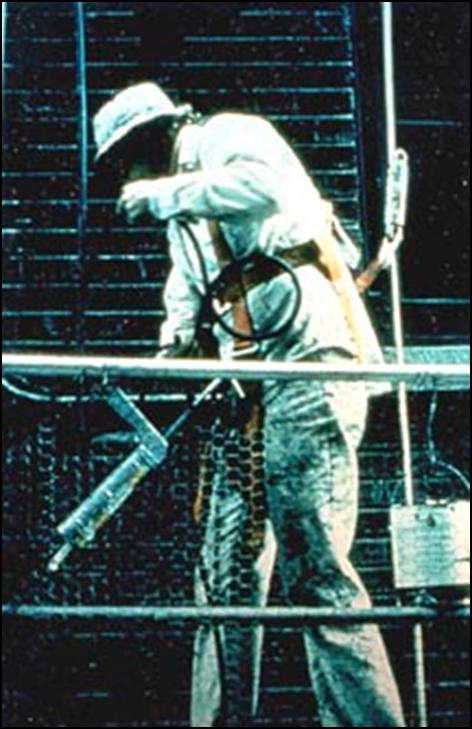
2.Personal Fall Arrest Systems...

lifelineThe scaffold competent person must determine personal fall protection requirements for employees performing erecting or dismantling activities, and for scaffold users if the scaffold is incomplete for any reason. Personal fall protection must be required and provided by the employer where the installation and use of such protection is feasible and does not create a greater hazard.
Personal fall arrest systems used on scaffolds are required when the guardrail system is incomplete or does not provide adequate protection. Lanyards or connecting devices must be connected to a vertical lifeline (1st choice), a horizontal lifeline (2nd choice), or a structural member of the scaffold (last choice).
3.Toeboards
Toeboards must be installed on work platforms where materials or tools will be in use. Toeboards must be installed not more than 1/4 inch above the platform and securely fastened. They may be made of solid material or mesh with openings no greater than 1 inch. Toeboards must be capable of withstanding at least 50 pounds applied in a downward or outward direction.

4.Nets and Platforms..

Additional protection from falling debris and other small objects must be provided in areas where personnel will be in the vicinity of scaffolds. Such protection may be in the form of:

  • Barricades to keep personnel out of a hazardous area,mesh
  • Screens which are erected between the toe board and hand rail of the work platform,
  • Debris nets to catch materials before they hit the ground, or
  • Canopy structures made of solid materials.
Large or heavy materials stored on the scaffold platform must be located away from the edges of the work platform and secured, if necessary.

Scaffolding Basic Components...

Intelligent design based on Layher’s unique connection technology provides verified high load-bearing capacity and reduces the required material to a minimum.

A few basic components form the basis for almost limitless uses.  There are many additional parts for special solutions, such as console brackets, stairs, aluminium beams, and edge protection. Layher Allround scaffolding is available in steel or aluminium.  All steel components are manufactured in Germany from high grade steel with superior hot dipped galvanising, and so are durable and virtually maintenance free.

7 basic components

Scaffolding basic components
» Adjustable base plate
» Base collar
» Standards
» Ledger
» Diagonal brace
» Deck
» Toeboard


Adjustable base plates (screw jacks)
Supported scaffold poles, legs, posts, frames, and uprights shall bear on base plates and mud sills (or other adequate firm foundation). Choose between different height-adjustable base plates with sturdy and self-cleaning round threads, with colour and notch markings to provide protection against overwinding. The size of the mud sill shall be based on the type of soil the scaffold will be erected upon.Swivelling base plates are available for sloping ground or uneven surfaces, e.g. in combustion chambers or ship hulls.


Base collar
Base collars..
The base collar with rosette together with the height-adjustable base plate form the scaffolding base. The vertical standard is then placed into the base collar for further construction.


Standards
Standards..
Standards are available in hot-dip galvanized steel, dia. 48.3 x 3.2 mm, or aluminium, dia. 48.3 x 4.0 mm, with rosettes at every 50 cm for a maximum of eight connections. Four small openings in the rosette determine right-angled connections, four larger openings permit connections at any angles.


Ledger
Ledgers..
Ledgers are available in different lengths, depending on the scaffolding bay length, deck type and load. Ledgers are both guardrails and bracing elements - no ledgers are required at deck level, which reduces the number of components required compared with other systems, saving weight and cost. U transverse ledgers and U bridging ledgers, with lock against lift-off (LALOs), reinforced ledgers, are also available.
Diagonal braces
Diagonal braces..
The diagonal braces with wedge brace the basic system together thanks to their high connection values.


Scaffold toeboards
Toe boards..
Toe boards are positioned between vertical standards, and are available in steel, aluminium or wood (which can be branded). The steel toe board reduces fire risk and is longer lasting. Due to  design, there are  gaps will be differ or no gap between the to board and deck.

Scaffolding deck
Decks..
Choose from decks made of hot-dip galvanized steel, aluminium, wood or an aluminium frame with plywood board. Or choose the latest technology in deck construction with the strong yet lightweight FIPRO deck (glass-fibre reinforced plastic). Decks provide bracing so ledgers are not required at deck level, saving cost and weight. Hatch decks are available, providing internal access via integrated drop down ladders.

Steel decks (planks)

Steel decks (planks)Steel decks are Perforated, non-slip steel decks are available in two widths, 0.32m and 0.19m, and lengths from 0.73m to 4.14m.


Lapping decks (planks)

Lapping decksThe lapping plank is a safe bridging element capable of bearing high loads. Planks are available in two widths, 0.30m and 0.19m, and lengths from 1.00m to 2.50m. Lapping planks are available with 1 or 2 locking pins.


FIPRO decks (planks)

Fipro decksDeck of glass-fibre-reinforced plastic with steel caps, 3 steel claws and steel edge guard. Non-slip, lightweight, strong and sturdy. Measuring 0.61m wide, and lengths of 2.57m and 3.07m.


Robust decks (planks)

Robust decksAluminium stile section, 3 plywood panel BFU 100 G 3 Phenolic resin coating and rot protection; 3 lightweight, non-slip, easily stackable. Measuring 0.61m wide and 0.32m wide, and lengths of 0.73m to 3.07m.


Hatch decks (planks)
Access hatch decks
Internal accesses can be built into the scaffolding with the hatch-type access decks. These decks are available with or without an integrated ladder for internal access.


The Leaders must have training..

There are also requirements that relate to the work of erecting, altering and dismantling scaffolds, i.e. they must be led by a competent person with sufficient knowledge and experience of such work. The foreman must have undergone general or special training. The foreman must also have access to the plan before the work is started.
The theoretical knowledge must at least include:
  • An understanding of plans for the erection, dismantling or alteration of scaffolds
  • Safety in the erection, dismantling or alteration of scaffolds
  • Measures to prevent the risk of people or objects falling
  • Safety measures that need to be taken when the weather changes in a way which adversely affects safety
  • Conditions as regards permissible loads
  • Any other risk which the above mentioned work of erection, alteration or dismantling may entail.

... and also those who erect

The person doing the work must have adequate training for the work to be done and the specific risks involved, according to one of the following alternatives:
  • General training is suitable for those working with scaffolds at a maximum height of 9 metre (four lifts) to the working level and where the design is indicated by a general instruction manual.
  • Special training is appropriate for those working with more complex scaffolds than those listed above.
Remember that ....
  • if a scaffold is manufactured abroad and is used in Sweden by people other than those employed by the company, such as subcontractors or companies carrying out work at the same work site, the scaffolding must be type examined by an accredited body. 
  • There must always be instructions on how to erect, use and dismantle along with instructions on how the scaffold should be maintained. The instructions must be available in the languages used by the workers at the workplace.
  • There must be documentation showing that the scaffold is sufficiently strong and stable at the maximum intended load.
  • There must be documentation showing that the scaffolding has been checked before it was delivered to be used. These checks are often made jointly by the erector of the scaffold and the person who has ordered it.
Safety
Besides load requirements, scaffolding platforms and workers implement other safety features. All platforms must have guardrails with a top, mid, and bottom rail if they are ten feet or more above the ground, says the North Carolina Department of Labor. Also, all workers should wear hard hats to protect them from falling objects. To protect the public from falling objects, scaffolding often has mesh guards or panels below the platform. Workers on suspension scaffolding often wear fall arrest body harnesses to protect them from falling.

10 Safety Rules in Scaffolding.....

Despite the dangers it poses, however, working on a scaffold can be straightforward and safe if everyone involved follows procedures.Safety laws outline specific duties and responsibilities for employers, supervisors and workers. Knowing the rules and regulations is in everyone’s best interest.

1.Ensure everyone is properly trained. Safety regulations require that workers be trained in the design and operation of scaffolding. Training covers important safe work practices such as how to safely get on and off the scaffold (using an access ladder, not the scaffold frame — unless it is specially designed to be climbed and both hands are free to grab the rungs). It should also cover comprehensive fall protection training specific to the type of scaffolding, erecting and dismantling procedures for anyone involved in these activities, and a host of other lifesaving details.

2. Take the time for prep work. Before using scaffolding, make sure the base is sound, level and adjusted; that the legs are plumb and all braces in place; that locking devices and ties are secured; that cross members are level; and that planks, decks and guardrails are installed and secure. Check the location for ground conditions, such as slopes, and stay clear away from hazards such as overhead wires, obstructions and changes in surface elevation.

3. Keep it legal. Samsung  standard committees have identified “rogue employers” as a significant obstacle to scaffold safety. “These are employers who fly under the radar and operate without a license,” says Mr.Kathikeyan,  Samsung Scaffolding Inspector. “They get some pick-up truck, rent a unit and hope they don’t get caught. They might import material from offshore and put it together without having it surveyed or reviewed by a professional engineer.”

4. Know and respect the load capacity.  According to the  Ministry of Labour, failure to consider all the loads to which the scaffold may be subjected is one of the top things that go wrong at the design stage. The scaffold must be strong enough and capable of holding the desired weight, otherwise it could collapse. Don’t try to fit more workers on the platform than it can handle; don’t overload it with equipment and materials; and don’t rest anything on the guardrails.

5. Ensure the scaffold is properly secured.All types of scaffolding must support, or have the ability to support four times their intended load plus their own weight, according to the North Carolina Department of Labor. Any guardrails need to withstand 100 pounds at the mid rail and 200 or more pounds at the top rail. Suspension ropes on suspension scaffolding must successfully support six times the intended load.

The scaffold must be adequately braced or tied to the building. If it is wrapped in a tarp for protection from the elements, it could blow over if it is n’t secured. According to the Construction Safety Association of Manitoba, “Bracing must be properly secured in place, otherwise scaffold movement may dislodge an end, reducing the stability of the scaffold. There are several different brace retention or locking systems found on scaffolds. These devices must operate freely for ease of assembly and dismantling, and also lock securely to prevent a brace from dislodging. Nails and other miscellaneous odds and ends should not be used in place of proper retention parts supplied by the manufacturer.”

6. Use guardrails. The design of the scaffold must incorporate guardrails on at least the three sides facing away from the building if the scaffold is more than 10 feet above ground. There should be a top rail, a mid rail and a bottom rail (toe board). If you must remove any guardrails while hoisting materials, replace them promptly. Wear fall protection at all times.

7. Inspect and maintain. Scaffolding must be routinely inspected by the supervisor and by a competent person — ideally a professional engineer or a person designated in writing by a professional engineer. In the case of a suspended platform, inspect and test all components including welds, stirrups, connecting pins, connecting plates, trusses, beams and working surface. Check that the lumber is of good quality. If any pieces get broken or damaged, replace them right away. Inspect frames, braces and other components for damage, bends and excessive rust or wear. Also check motors, platforms or wire ropes for damage from chemicals or corrosive material.

8. Good housekeeping. There isn’t much room on a scaffold, so it’s important to store tools and materials in an orderly fashion. Keep the platform free of obstructions. Place debris and waste material in a container or remove it from the platform immediately.

9. Keep your balance. A scaffold and its platform must be perfectly level (CSA standard says it mustn’t deviate from the vertical by more than 12 millimeters per three meters of height) to minimize the risk of workers losing balance and falling off. Particularly on swing stages, there must be an adequately weighted counterweight. Pay attention when working on a scaffold. Any sudden movements, or reaching too far from the platform, can cause a loss of balance.

10. Use appropriate PPE. This includes head protection, non-slip protective footwear  and fall protection as required, in the form of a safety harness tied off to a solid structure, such as the building. Ontario’s construction safety regulations indicate that the harness can be tied off to the suspended platform or scaffold only “if all or part of the platform or scaffold has more than one independent means of support and the platform or scaffold is so designed, constructed and maintained that the failure of one means of support will not cause the collapse of all or part of the platform or scaffold.”

With all of these safety practices in place, working on a scaffold can be a high without the dangerous lows.

 Written by M.Ajmal Khan.

Thanks: Mr.Anbazagan (PMT-SATORP)
              Mr.Karthikeyan(Scaffolding Supervisor-SAMSUNG)

Monday, 12 September 2011

Attention to students seeking Engineering studies..


Students, become too apprehensive after completing school education thinking that engineering studies alone can get good earnings and facilitate to obtain lot recognition in life. They begin to contemplate and worry on various issues concerning the college - Would I get that particular Department?  Would I get a seat in the specific college that I had planned? And ultimately confuse their parents too.
Right from the day of result to the day of admission into an Engineering college, the students go through lot of anxiety. These two months are very important months in the student�s life. Here, we have some useful tips on, what to do and what not to do, during this important phase.  
  • Many students around you might study engineering or wish to study engineering. Therefore, that doesn�t mean that you should also study engineering and leave behind the thought that only through engineering studies your future life would be good. Reflect on yourself, whether you naturally possess an aptitude towards engineering studies? Beyond that, you ought to make a detailed study on the interest you possess on Engineering studies.  Well, if you thing that the field of Engineering is for you, you can proceed to the next points.
  • You can like or wish to study specializations like Mechanical, Civil, Electrical and IT. But, the most important thing is that before opting the study you should know about the area of specialization. If you happen to know few things about studies you are planning select, it would easy and would be able study with interest. What is the nature of the particular studies? What does the study comprise of?   What are future scopes for the studies?
  • Students should possess very good clarity on the specialization to choose in Undergraduate and Post Graduate studies. Regarding this, get advice from an appropriate person. 
If you have special interest towards the field of aeronautics, instead of opting for the aeronautics at Under Graduate level, it would be good if you opt for Mechanical in the UG and opt for Aeronautical at the Post Graduate level. Hence, it is very important to know such types of intricacies.  
  • Further, it is not only enough to know your area of specialization, but it is very important to know about other specializations in the field of Engineering to face the challenges in the future.
  • Do not select a college just because your friend has got into it. He/ She would have selected a college and a course based on his/her interest, economic background and family situation. Similarly, you should take a decision based on your family background. Even without studying together you can continue your friendship. At any point of time you can meet and revive your friendship.  
  • Important details like the selection of course and college must be made by you in consultation only with your family members. Don�t go by the word of any stranger or outsider; instead just take it as a word of advice. To get more information you could seek the help of your teachers or some experienced education counselors. Ultimately, the family should take the decision in consultation with their child who is about take the studies. 
  • Obtaining very good marks and joining in one of the best colleges in the state would not ensure a bright future. It is important to work hard, develop employable skills and get good marks in college for all the dreams to become a reality.
  • Most of the time you may get a desired college, but not the desired course. At times you may get the desired course, but not the desired college. Start studying the course you have got, don�t be worried about such issues.  It is good to give importance to a good college, instead of a desired course. Only then you can get all the opportunities. 
  • Don�t go to an educational consultancy or the college administration to know about the college. Instead ask old students of the college or senior students of the college, they will be able to give appropriate information about the college. Otherwise, if you have anybody working in the college they would be able to give authentic information about the college.   
  • At the time of counseling don�t be tensed and nervous. Such a mental state would not help in proper decision-making. Take a clear and firm decision at home and reach the counseling spot at least 2 hours earlier.  
  • There are some differences between school study and engineering study. The students, who scored good marks in school's mathematics syllabus, may feel difficult in Engineering syllabus. So, you need hard working attitude in your Engineering studies.
Don�t be negligent. Keep too much entertainment at bay and concentrate on studies. Only then, the money and time that you and your parents invest will be rewarding.
  • Don�t ask any question to operators in the counseling hall because they don�t know anything as they have been just hired for a part time basis and are not regular employees who know the in and out of counseling. Don�t have conversation with anyone in display hall also, as you will get confused.
  • As your name will be registered in system immediately after your fee payment, you should not go anywhere, but wait for further instruction in the waiting hall. They may call you at anytime. If you move to the display hall, you may not be able to hear the announcement and probably loose your chance.
  • It is a misconception that the best colleges are available only in metropolitan cities and only these colleges have good infrastructure facilities. You should understand that there are so many colleges with excellent facilities in small towns of Tamil Nadu and there are lots of fake colleges in metropolitan cities also.

Saturday, 10 September 2011

The Importance of having Breakfast...


You may not be the only one, as many people, who know the benefits of eating a healthy meal, still leave the house in the morning without having consumed a filling or adequate breakfast.
Most people who skip breakfast or who eat an unhealthy one use either lack of time in the morning or weight watching as their excuse.
We will explain further on in the article that skipping breakfast in order to lose weight is a total misconception that holds absolutely no truth and in fact the opposite is true, in that skipping breakfast, in some cases, could cause you to become overweight.  
What happens to our body first thing in the morning?
If you consider that when we wake up in the morning, for the majority of us, our body and brain have been without food for around 10 - 12 hours and for children it may be longer.
Our body is similar to a car in the fact that it needs fuel to run, and like a car, the better you look after your body, the longer and better it will run.
Our bodies must be fuelled several times each day so that we function efficiently and carry out our daily tasks as best we can. In the morning, after many hours without food, it is essential to refuel in order to provide the necessary nutrients and energy to get us through the first part of the day. 
Why is it important to fuel our brain?
It is from our brain that messages are sent to other parts of the body to get them moving and working well.
If our brain is not fed, it will act in a slow and sluggish manner, which will impact greatly on the rest of our body.
The brain requires glucose or blood sugar to provide it with energy to function, whilst the muscles of our body need glucose to activate them and get the body working physically.  
To work and feel well, our blood sugar levels must be maintained at a certain level. After long periods without food, our blood sugar levels fall, causing tiredness and irritability amongst other symptoms that occur when you need food. 
The disadvantages of not having breakfast
If you deprive your body of food in the morning you may find that you feel tired, dizzy and irritable and that your concentration is poor. It may take you longer to carry out tasks or you just might not feel up to anything mentally strenuous let alone physical. You will probably find yourself snapping at people unintentionally, especially if under stress and you will no doubt soon start to feel pangs of hunger as the morning wears on.
If you don't eat anything in the morning, you will most likely find yourself craving something sweet to eat, as your body cries out for a quick fix to boost energy levels. If you are at work and it is not yet time for lunch, this is one of the moments when you may find yourself reaching for something very unhealthy such as a chocolate bar, croissant, cream cake or other unhealthy snacks. For those who are watching their weight, this is disastrous.
It is also possible that you may become so hungry that you grab twice as many unhealthy snacks to eat before lunch or even end up eating all of your packed lunch by 11.30 am. 
No breakfast does not equal losing weight
Some people erroneously think that by skipping breakfast, they will reduce their calorie intake for the day and that it will help them to lose weight.
Not only are you giving your body the worst possible start in the morning and putting it under unnecessary pressure, this is also not the case.
Missing breakfast often leads to overeating at some point later on in the day, usually snacking on unhealthy foods, which are high in calories and fat. You may also become over hungry mid-morning and by lunchtime could end up eating twice as much than if you had eaten a healthy breakfast that released energy slowly throughout the day.
Three healthy square meals or six smaller meals a day should keep you going throughout, without having the need to snack in between. 
The disadvantages of not eating an adequate breakfast
People who start the day with a strong, sweet cup of coffee and a croissant, Danish pastry or bowl of sugar-loaded cereal, may think that because they have eaten something, that they are starting the day well, and providing their body and brain with a good start to the morning. They may also wonder why, their energy boost doesn't last very long and why they are ravenous mid-morning even after having consumed breakfast first thing.
This is because although they did make time to have breakfast, their breakfast choice was very poor.
Caffeine, as we all know, gives you instant energy and many people feel that they cannot start the morning or even go through the day without at least several shots! In actual fact, caffeine produces adrenaline, which sends some of the body's stored glucose to the brain.
Cereals high in sugar have very little nutritional value. When eaten their high amounts of sugar are released almost immediately into the bloodstream (sugar fix) and provide an instant energy boost.  
Together with the caffeine, blood sugar (glucose) levels rocket and energy levels soar.
The downside of this effect is that the energy boost is extremely short-lived. As the pancreas responds to this surge of glucose, it produces insulin in order to bring the levels back down to a reasonable amount.
This means that a few hours after this unhealthy breakfast, you are left feeling tired and hungry again and in need of another quick sugar fix.    
The advantages of a healthy and nutritious breakfast
After a good night's sleep and with an empty stomach in the morning, it makes sense that the best way to start the day and to energize and revitalize your body, is with a filling, nutritious and healthy breakfast that will keep you satiated until the next meal.
Our body needs a healthy breakfast packed full of vitamins and nutrients whilst also providing energy and fuel for the brain.
The best types of foods to be eaten at breakfast are complex carbohydrates such as whole grains including oats, rye bread and millet together with a small amount of dried fruit and freshly squeezed juice.
These foods have a low GI (glycaemic index), which means that they release glucose steadily and slowly into the bloodstream, unlike the unhealthier breakfast choices mentioned earlier. Consequently, these foods will keep you fuller for longer, prevent unhealthy snacking, keep energy levels steady without dipping and provide you with essential vitamins and minerals that may be missed at other meals.
Many people like to consume some form of protein in the morning, as protein balances blood sugar levels and recent studies have also proven that concentration levels are enhanced if some form of protein in consumed during the breakfast meal.
Excellent sources of protein, which can be incorporated into the breakfast meal are eggs, fish, nuts and seeds. Eggs are a particularly rich source of choline (B vitamin), which the body converts into acetyl-choline, a neurotransmitter found in the brain.
Studies show that adults and children who eat breakfast in the morning perform better at school and at work. It is proven that with breakfast, concentration and memory improve, mental performance and problem-solving ability is better and learning ability is increased.
Not only this but studies generally prove that most people who eat breakfast manage their weight better, are not obese or overweight, have lower levels of cholesterol, which means they are less likely to suffer from heart disease and are generally in better health overall, not to mention in better mood.
In children, their concentration and productivity at school is better and they are more creative, interested and alert.  

Warning: The reader of this article should exercise all precautionary measures while following instructions on the home remedies from this article. Avoid using any of these products if you are allergic to it. The responsibility lies with the reader and not with the site or the writer.This information is solely for informational purposes. IT IS NOT INTENDED TO PROVIDE MEDICAL ADVICE and should not be treated as a substitute for the medical advice of your own doctor.
Rest in Next

“The truth is rarely pure and never simple".
Collection By  M.Ajmal khan.